JEGS Do-not-reorder Push Release Pin Shaft 889944088042 Do-not 1/2
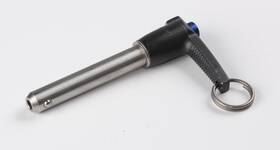
( Brand: Jegs ), ( Manufacturer Part Number: DO-NOT-REORDER ), ( Part Type: Pin Shaft ), ( Country Of Origin: Usa ), ( UPC: 889944088042 )
Review JEGS Push Button Quick Release Pin 1/2 Inch Diameter Shaft Size
The **Push Release Pin for 1/2" Shaft (Part Number: 889944088042)** is a precision-engineered mechanical component designed to provide a secure yet easily releasable connection between a rotating shaft and its attached component, such as a pulley, sprocket, or coupling. Crafted from high-quality **chrome-molybdenum alloy steel**, this pin is heat-treated to achieve an optimal balance of strength, durability, and resistance to wear, ensuring reliable performance even under demanding operational conditions. The pin features a **smooth, cylindrical shaft** with a **slight taper or interference fit** at its base, allowing it to be pressed or driven into a pre-drilled hole in the shaft or hub with minimal clearance, preventing axial movement while accommodating minor misalignments. Its **smooth, polished surface** minimizes friction and wear on the shaft, reducing the risk of galling or scoring over extended use, which is particularly beneficial in applications involving high-speed rotation or cyclic loading.
One of the standout features of this push release pin is its **easy installation and removal mechanism**, which is critical for maintenance, equipment servicing, or component replacement without requiring specialized tools. The pin is designed to be **driven into place using a press fit or impact tool**, such as a hammer and drift pin, and can be **easily removed by tapping it out with a soft-faced mallet or using a pin punch** a feature that simplifies routine maintenance tasks. The pin s **standard 1/2" diameter** makes it compatible with a wide range of industrial machinery, including conveyor systems, agricultural equipment, automotive components, and power transmission assemblies, where quick disassembly is essential for efficiency. Additionally, the pin s **uniform cross-section and consistent tolerances** ensure a snug yet non-permanent fit, allowing for repeated installation and removal without compromising the integrity of the shaft or the pin itself.
For applications where corrosion resistance is a concern, this push release pin can be **plated with zinc, cadmium, or other protective coatings** to enhance its longevity in wet or harsh environments. Its **standardized dimensions** adhere to industry specifications, ensuring compatibility with existing machinery and reducing the need for custom modifications. Whether used in **heavy-duty industrial settings, automotive transmissions, or precision machinery**, this pin delivers a dependable solution for applications requiring a removable yet secure shaft connection. Its robust construction, ease of use, and versatility make it an indispensable component for engineers, mechanics, and maintenance technicians looking for a reliable fasteners solution that balances strength, convenience, and longevity.
### **Analysis of buying a Part: 889944088042 (Push Release Pin for 1/2 Shaft)**
#### **Overview**
The part **889944088042** is a push-release pin (likely a type of **quick-release or latch pin**) designed for a **1/2-inch shaft**, commonly used in mechanical applications such as **hydraulic cylinders, agricultural equipment, industrial machinery, or automotive components**. These pins are often used to secure shafts in place while allowing for rapid disassembly without tools.
---
### **Pros of Buying This Part**
1. **Quick and Easy Installation/Removal**
- Push-release pins are designed for **tool-free assembly and disassembly**, saving time and labor in maintenance or repairs.
- Ideal for applications where frequent disconnection is required (e.g., hydraulic hoses, tool attachments, or modular machinery).
2. **Durability and Load-Bearing Capacity**
- High-quality push-release pins are made from **hardened steel or alloy materials**, ensuring resistance to wear, corrosion, and fatigue under cyclic loading.
- Many are **spring-loaded or self-locking**, providing consistent retention without loosening over time.
3. **Compatibility with 1/2 Shaft**
- The **1/2-inch shaft size** is standard in many industries, making this pin widely applicable for replacements or upgrades in existing systems.
- Fits common **spline shafts, keyed shafts, or smooth shafts** depending on the pin s design (e.g., some may require a keyway or groove).
4. **Cost-Effective for High-Turnover Applications**
- Eliminates the need for specialized tools (e.g., cotter pins, set screws, or Allen keys), reducing downtime and labor costs.
- Often cheaper than alternative locking mechanisms (e.g., clamp collars or threaded couplings) for temporary or semi-permanent use.
5. **Reduced Risk of Damage**
- Unlike threaded fasteners, push-release pins do not require tightening, which can strip threads or deform shafts over time.
- Some designs distribute load more evenly, reducing stress concentrations.
6. **Versatility in Applications**
- Used in **hydraulics, pneumatics, construction equipment, farm machinery, and industrial conveyors**.
- Available in different materials (e.g., stainless steel for corrosion resistance, carbon steel for general use).
7. **Easy Replacement**
- If damaged or worn, the pin can be quickly replaced without disassembling the entire system, reducing maintenance time.
---
### **Cons of Buying This Part**
1. **Limited Load Capacity Compared to Permanent Fixes**
- Push-release pins are **not as strong as welded, bolted, or keyed connections** for high-torque or high-vibration applications.
- May not be suitable for **critical safety components** where failure could cause injury or equipment damage.
2. **Potential for Misalignment or Play**
- If not installed correctly, the shaft may **wobble or shift**, leading to premature wear in bearings or seals.
- Requires precise **groove or slot alignment** on the shaft; improper fit can cause binding or failure.
3. **Material and Quality Variability**
- Lower-quality pins may **corrode, bend, or break** under heavy loads or harsh environments (e.g., outdoor exposure, chemicals).
- Some generic or aftermarket pins may not meet **OEM specifications**, leading to compatibility issues.
4. **Not Reusable in All Cases**
- While many push-release pins are reusable, **extreme wear or deformation** (e.g., from overloading) may render them unusable.
- Some designs (e.g., those with internal springs) may lose effectiveness after repeated use.
5. **Limited Customization**
- Standard push-release pins may not fit **non-standard shaft configurations** (e.g., tapered shafts, unusual grooves, or non-circular profiles).
- Custom machining may be required for specialized applications.
6. **Potential for Misuse Leading to Failure**
- If forced into place or overloaded, the pin or shaft may **shear or crack**, leading to sudden failure.
- Not suitable for **dynamic applications** (e.g., rotating shafts under high centrifugal force) without additional locking mechanisms.
7. **Environmental Limitations**
- Some materials (e.g., plain carbon steel) are **susceptible to rust** in wet or corrosive environments.
- High-temperature applications may require **specialized alloys** (e.g., stainless steel or heat-treated steel).
8. **Dependence on Proper Installation**
- Improper installation (e.g., incorrect groove depth, misalignment) can **void the pin s function** or cause shaft damage.
- Requires **basic mechanical knowledge** to ensure a secure fit.
---
### **Key Considerations Before Purchase**
1. **Application Requirements**
- Determine if the pin is for **static or dynamic loading** (e.g., a hydraulic cylinder vs. a rotating tool attachment).
- Check **load capacity limits** (usually specified in pounds or kilograms) to ensure it meets your needs.
2. **Shaft Compatibility**
- Verify the **shaft diameter, groove type (if any), and material** (e.g., steel vs. aluminum).
- Some pins require a **specific groove depth or width**; measure your shaft to confirm fit.
3. **Environmental Conditions**
- Will the pin be exposed to **water, chemicals, extreme temperatures, or vibration**? Choose the right material (e.g., stainless steel for corrosion resistance).
4. **Brand and Quality**
- Opt for **reputable manufacturers** (e.g., **Husky, Snap-on, or industrial hydraulic suppliers**) to avoid counterfeit or low-quality pins.
- Check for **certifications** (e.g., ISO, SAE standards) if the application is critical.
5. **Alternatives**
- If push-release pins are insufficient, consider:- **Clamp collars** (for permanent but removable connections).
- **Keyed shafts** (for higher torque transmission).
- **Threaded couplings** (for adjustable or removable shafts).
- **Welded or bolted connections** (for permanent fixes).
6. **Cost vs. Benefit**
- While push-release pins are **cheap upfront**, ensure they align with your **long-term maintenance needs**.
- For high-stress applications, a slightly more expensive but higher-quality pin may be justified.
---
### **Conclusion**
The **889944088042 push-release pin for a 1/2-inch shaft** is a **practical and cost-effective solution** for applications requiring **quick, tool-free disassembly** without permanent damage to the shaft. It excels in **maintenance-friendly, low-to-moderate load scenarios** where ease of use is prioritized over maximum strength.
However, it is **not ideal for high-torque, high-vibration, or critical safety applications**, where permanent or reinforced connections (e.g., keys, welds, or clamp collars) are necessary. **Quality, proper installation, and environmental suitability** are critical to ensuring reliability.
---
### **Recommendation**
- **Buy this pin if:**- You need a **quick-release solution** for a **1/2-inch shaft** in **hydraulic cylinders, tool attachments, or modular machinery**.
- The application involves **frequent disassembly** (e.g., hydraulic hoses, farm equipment, or industrial conveyors).
- The load is **moderate and not subject to extreme stress or vibration**.
- You prioritize **cost efficiency and ease of use** over maximum load capacity.
- **Avoid this pin if:**- The application requires **high torque, dynamic loading, or critical safety performance**.
- The shaft lacks the **correct groove or alignment** for proper pin installation.
- The environment is **highly corrosive, extremely hot, or prone to heavy vibration**.
- You need a **permanent or ultra-high-strength connection** (consider keys, welds, or clamp collars instead).
- **Best Practices for Purchase:**- **Verify the pin s material** (e.g., stainless steel for corrosion resistance).
- **Check load ratings** to ensure it matches your application s requirements.
- **Purchase from a trusted supplier** to avoid counterfeit or low-quality pins.
- **Test-fit the pin** on your shaft before full installation to confirm compatibility.
- **Consider a backup pin** in case of wear or failure.
For most **non-critical, maintenance-oriented applications**, this push-release pin is a **sound choice**. However, always **evaluate your specific use case** to determine if it meets your needs long-term. If in doubt, consult a **mechanical engineer or equipment specialist** to assess alternatives.
Details:
specifications accperformanc:
- brand: Jegs
- mpn: Do-not-reorder
- part type: Pin Shaft
- country of origin: Usa
- upc: 889944088042
payments accperformanc:
- other
- wallet: Paypal
- credit card: Mastercard
offer accperformanc:
- quantity: 10
- started: May 1, 2026
- options: Ship-to-home
- sold: 0
- availability: In Stock
seller accperformanc:
- # reviews: 627995
- city: , Ohio
- rating: 99.4%
general accperformanc:
- condition: New
- Parts Accessories > Permance Racing Parts > Accessories
returns accperformanc:
- paid by: Seller
- policy: Returns Accepted
- time: 30 Days
shipping accperformanc:
- service: Standard
- transit: 4-7 Days
- type: Fixed
- cost: $15.99
- class: Standard
Jegs DO-NOT Is Similar To:
- 52137 Jegs Performance Products Low Profile Electric Fan Diameter 889944056829 (27.7% similar) ...(May 21st, 2018)
- 64106 Jegs Performance Products Rod End With Jam Nut Hole Thread (33.1% similar) Brand new rod end with jam nut. Thread, 5/8 hole. 4 available...(March 25th, 2018)
- 80905 Jegs Performance Products Valve Stem Caps With Magnum 889944093190 (17% similar) ...(May 22nd, 2018)
- 80906 Jegs Performance Products Valve Stem Caps With Bullet 889944093206 (17% similar) ...(May 22nd, 2018)
- 84108 Jegs Performance Products Flange Nuts Socket Size 889944090885 (18.8% similar) ...(July 30th, 2018)
- 10330 Jegs New Snap Action Switch With 6 Coil Cord 012657001569 (31.9% similar) Product features micro switch with cord fingertip sized 18 gauge wire 6' long retail package not included to save you money on shipping. A 5/8 hole is required for installation. This part has never been used or installed. This listing is for a new snap action switch with 6' coil cord this switch's ...(April 20th, 2016)
- 130010s Jegs Cody Coughlin Signature Hoodie Size Large New Without Tags (26.3% similar) ...(February 8th, 2016)
- Jegs 681262 Ssr Star Wheel Diameter And Width 15 X 7 Inch (39.1% similar) Meets or exceeds sae fatigue standards. Sleek 5-SPOKE design with gloss black powder coat finish. Cap 555-69154. Includes 2/3 /8 in. For street use only as these are not designed for race. Dot approved. Transform your ride with a completely different look. Wheel load rating chart. 555-681262 SSE ...(November 30th, 2023)
- Jegs 10378 Battery Quick Connect 175a 600v (38.7% similar) 175A, 600V, appears to be old stock. Photographic evidence of defect or basis for return must be submitted at time request. Model: 10378. Phone number. 10378 battery quick connect...(April 27th, 2024)
- Jegs 889944042914 32000 Starter Heat Insulator 7 Inch X 24 (43.2% similar) ...(August 16th, 2024)
- Jegs 81451 72 Inch Rolling Tool Cabinet Stainless Steel Includes 15 Lockable D (27.7% similar) Heavy wrapping/impact protection is used during packing to prevent damage and the unit placed on its own pallet for shipping. Upper cabinet doors have two lift cylinders each, a magnetic closure, and an adjustable height shelf, each independently locks. Includes anti-tip hardware to secure wall. ...(August 19th, 2024)